disclaimer: i've only read select portions of the below readings. but as always for a uni student i'm doing it all seemingly haphazardly. this must change with time.
readings
Michel de Certeau defines 'space' and 'place' as thus: space is a practiced place. place refers to the physical location and placement of objects, and space is the meaning upon which we affix through social constructions to the interaction of said objects. with 'place' and 'space' come two different forms of narrative - the map and the tour. this is evident in our narratives describing a location: the directions are either cardinal or relative based upon the perspective you choose to use.
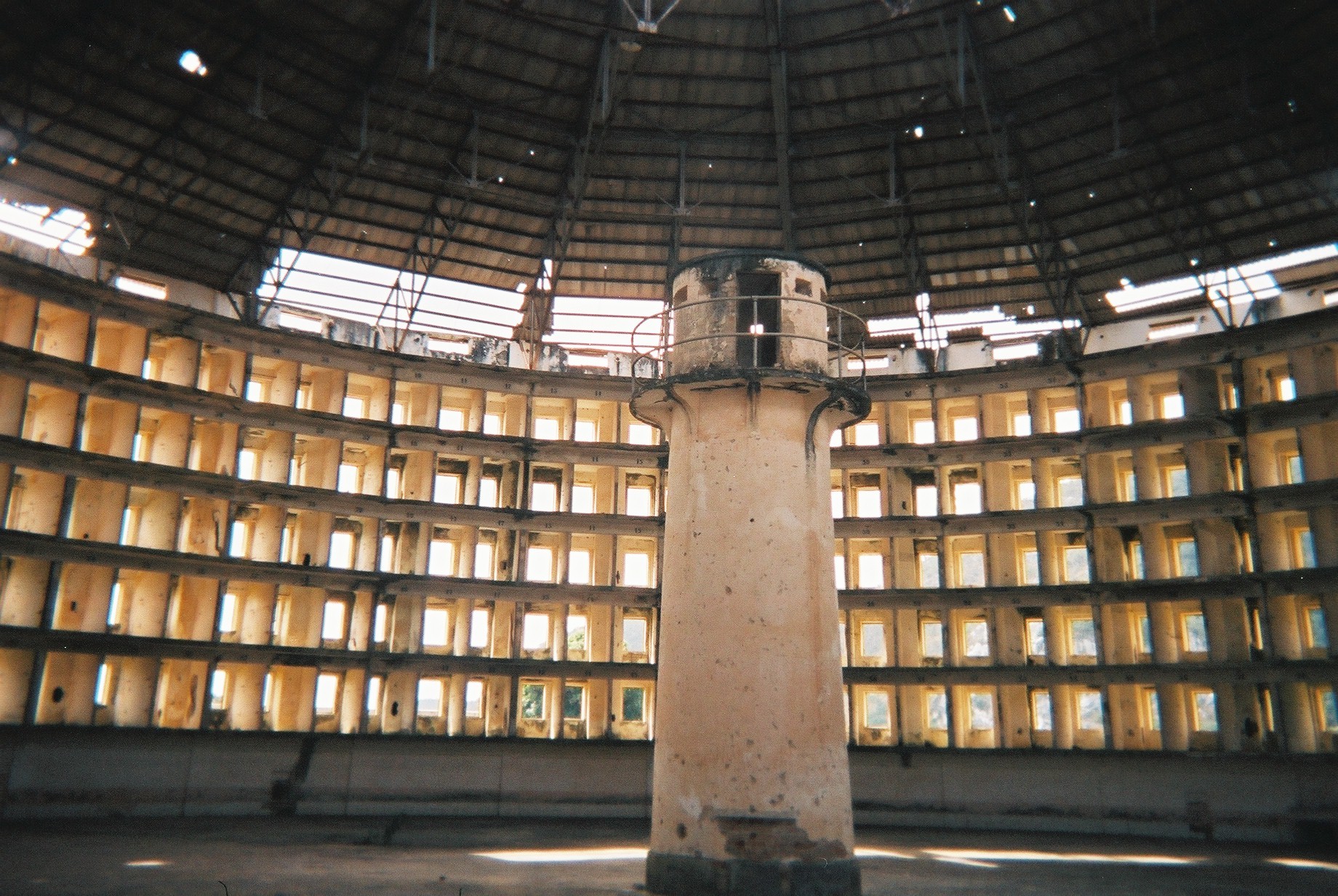
Foucault describes a few concepts worth noting here. firstly is the idea of examination, that the individual has become subject to the normalising scrutiny of institutional regulation. second is the idea of docile bodies, that the body itself can be moulded and socialised accordingly. last is his famous adaptation of Jeremy Bentham's panopticon, and the fear of something that holds people back from acting.
in an examination of violence, Gavin de Becker describes the role of intuition in determining actual threats to your safety and well-being. now, this intuition is something often rationalised out, ruled out, discounted as unfounded. but it is akin to animal instinct, because it takes into account those cues that the conscious mind doesn't seem to be too good at sorting relevance to.
case
there was an incident the other night on a bridge where i approached a man physically restraining and verbally abusing his girlfriend. there was a short period of time where i tried to ascertain the situation, and the woman yelled for me to get her out of the situation; he let go when i told him to, and then followed probably ten minutes of extremely disturbing interaction (between them) and attempts (by me) at communication. i eventually got the woman to start walking, then when the man followed, i ended up calling the police on them; apparantly they are known by the police, whatever that means. the man was cuffed and questioned; i don't know what happened afterwards, because i left. i won't go into further detail here about the incident, it's all torrid and i've questioned my actions/inactions to bits already. the key point is that what made me very uncomfortable was (a) at some points i was actively being used as a human shield by both parties; (b) the woman appeared frightened, but had no instinctive movement to escape.
now (a) is simply a matter of sloppy body placement on my part, which can be resolved by more training. but what do i mean by (b)? i mean that at more than one point i positioned myself in a way that would allow her to run with a good head start to the more crowded part of the street not too far off. and in each case she did not properly try to get away, even with verbal cues. she allowed her phone to be grabbed at one point, and was intimidated onto the road at one point. the whole time the man threatened with motions violence, but since he never actually threw a strike i did not engage. instead the woman seemed paralysed by her fear of the immediate presence of the man and did not seem cognizant of the need to escape a threat.
applied theory
the incident was disturbing because the man exhibited all the signs of threat to me. the woman too exhibited all the signs of utter fear. but other than his behaviour stopping her freedom of movement, and threats, there was no actual violence. now let me make this quite clear.
if somebody is continuously restraining you from walking down a sidewalk, and pulls punches inches from your face to illustrate their conviction, i believe (unless under extenuating circumstance) that you should highly consider rearranging their face.
now it could be argued that with an extremely low-level grasp of basic chinese pugilism, i have recognised that there might be other options of resolving an incident as uncomfortable as the one i've sketched above. but what about this woman? significant other role aside, why would she not be able to see options for an exit?
firstly there is the erroneous belief that the police monopolise violence. on paper that is not even true. if the police had a monopoly on violence, would there be violent crime? if there was no violent crime, would the police exist to function as they do? police are institutional individuals that do have the power of enforcing compliance, but that itself preassumes their presence (in violent situations, a potential presence could be insufficient). in this case a quick telephone call was sufficient, but even so, the police took probably five minutes to arrive. this is not a critique at all of the police; on the contrary i think that they resolved this particular incident with an admirable lack of violence. but even if unlike myself, you are more critical of the role or respectability of police, i believe we can agree that the gaoler is not always watching every cell in the panopticon.
with the assumptions of foucault, we must then ask, if we may be socialised towards the incident with an unnatural inability to flight or fight, how do we keep ourselves safe? the police cannot safeguard every individual at once, and the very existence of the police department suggests that violence is a real threat. that this is the second incident i have gotten entangled in over the past three months would seem to support that opinion.
there exists a veritable panoply of legitimate self-defense and martial disciplines, that share the commonality of personal safety in confrontations (for the sake of simplicity let us keep weapons out of consideration here). now each of them is a discipline upon your docile body, a patterning of socialisation towards conversations of violence. each discipline has examinations that apply a normalising gaze by adhering to the discipline your docile body becomes fluent in this dimension of human interaction. this is turning Foucault's observations to your advantage; by subjecting yourself to the discipline's examination, you are gradually, on paper, better equipt to handle yourself in an incident.
now as for cardinal and relative directions, space and place, what bearing does de Certeau and Levinson have on this discussion? well the narrative of most east asian systems is form, a predetermined pattern of body movement. this construes the alphabet of movements that your body is disciplined to functioning in. now an examination of your form is able to reveal your proficiency (supposedly as effectively as sparring) in the discipline, and the form itself is a spatial reconfiguration of your directional sense.
more on that: a form is a journey, not a map, taken by your body in movement. a beginner's level is that of the map: particular static postures are memorised. but it is the transition between postures that matters more, and that is a journey, which basic practice should be. certain motions demonstrate principles, such as striking, throwing and joint manipulation. but practice of a form is a spatial story, which transforms place through practice into space. if this is a space which you can negotiate fluently, your safety is a little more likely.
conclusion
if it is not the police who are the gaolers of the panopticon, who is it? could we say that it is violence, the threat of which socialises people into an atmosphere of fear? if that is the case, if it is the threat of violence which we are fearful of, then perhaps it is worth subjecting your docile body to examining a discipline that socialises yourself into a particular spatial narrative. perhaps this will serve to quell those unreasonable fears that prevent people from negotiating their own safeties.


Subscribe to:
Post Comments (Atom)

No comments:
Post a Comment