Dry season is a bit of a misnomer, actually. Even in dry season there are still things moving and growing and living and dying.
On that thought maybe dry season is an appropriate description of my current itation. It is easy to become disheartened with a seeming lack of results or much vaunted progress, particularly when not institutionalised in some academic field. So instead I guess I'll have to turn back here and write what's been on my mind of late in that direction.
Seven Names for the Bellbird
I met a visiting ethnoorinthologist, who suggested this book on conservation geography. I must say that I do not think it is the most captivating book, but similar to "Behind the Smile" discussing Bajan tourism, the author has definitely been trotting around and taken some degree of insight into the situation. I wonder about this caliber of ethnography, which I find difficult to think of as particularly noteworthy, but is technically sound and not unpleasant to read. What distinguishes it from higher calibre works? I guess perhaps the value of conclusions and the way that they are presented. The narrative tone is delicate: too little and the work seems mechanical and boring, whereas too much and it seems like a thinly disguised travelogue.
At the same time it makes me think, and it makes me look for the historical continuum of texts that any further discussion should be versed in when it comes to "Caribbean and Central/Latin/South America" and the social sciences. Of particular concern is the analogue in another setting: for instance a book on fish markets and the centre/periphery economic movement in Tokyo, and one in Mwanza. How can one find all the precedents without painstaking research and sometimes dumb blind luck? It further begs the question, what is good writing? How does the author construct a new text within the established framework that any scholar must pay at the very least lip service to?
Moshe Feldenkrais
My first reading was a work of his on judo, where the technical section was prefaced by an extraordinarily articulate argument for the study of judo as an educational method. So I decided to read his "Awareness of Movement" and promptly got struck. Have not finished yet.
Suddenly I'm looking at something (the later developed Feldenkrais Method) that is eerily reminiscent of RMA breathwork, with reasonable axioms for motion such as efficiency over effort, and changing the relationship between the individual and their self-image to overstand chronic pain, poor structure, etc.
But it is the reasoning that he lays out that makes me believe the man is a serious character. In very simple language he outlines social theory as related through human movement and awareness of movement with such candor that I kept checking to make sure I wasn't reading a social sciences manuscript.
I understand that there are practitioners. I think some might be in the same city. Time and resources permitting, I am genuinely intrigued.
31.8.11


3.5.09
structural considerations

Sometimes you have to consider what sort of insights can be drawn from games. If they may succeed where fearmongering fails (and I hope at least something does), what might that say about our world created? And yet thus far a game can be perplexing too. The game itself can be set into an examination of structural considerations, and can be used to improve skillsets.
Culture creates all sorts of learning tools for language, for mathematics, for sciences, in songs, mnemonics, exercises, and even jokes!
Goodnight.
14.4.09
On the Everyday Practice of Life
disclaimer: i've only read select portions of the below readings. but as always for a uni student i'm doing it all seemingly haphazardly. this must change with time.
readings
Michel de Certeau defines 'space' and 'place' as thus: space is a practiced place. place refers to the physical location and placement of objects, and space is the meaning upon which we affix through social constructions to the interaction of said objects. with 'place' and 'space' come two different forms of narrative - the map and the tour. this is evident in our narratives describing a location: the directions are either cardinal or relative based upon the perspective you choose to use.
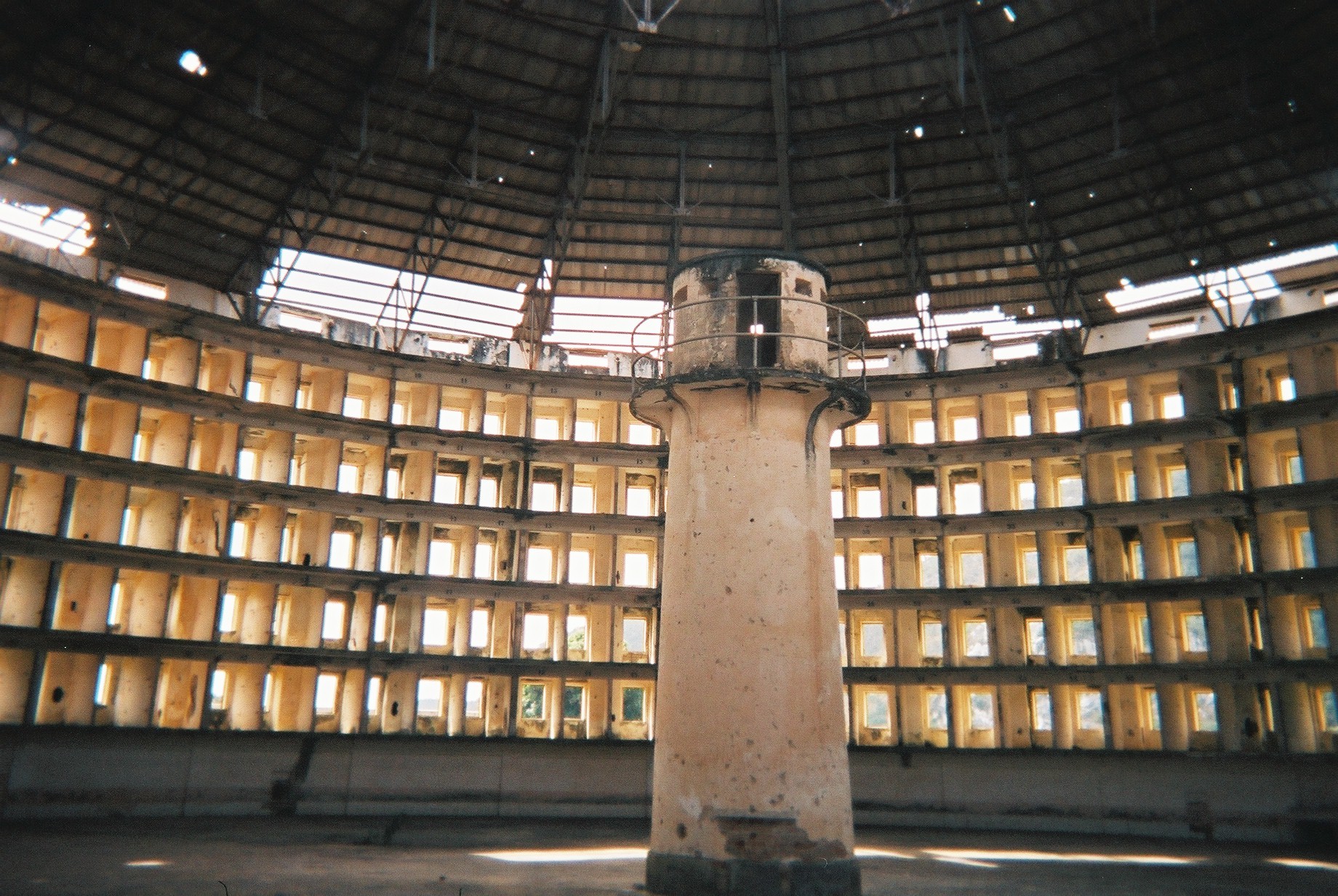
Foucault describes a few concepts worth noting here. firstly is the idea of examination, that the individual has become subject to the normalising scrutiny of institutional regulation. second is the idea of docile bodies, that the body itself can be moulded and socialised accordingly. last is his famous adaptation of Jeremy Bentham's panopticon, and the fear of something that holds people back from acting.
in an examination of violence, Gavin de Becker describes the role of intuition in determining actual threats to your safety and well-being. now, this intuition is something often rationalised out, ruled out, discounted as unfounded. but it is akin to animal instinct, because it takes into account those cues that the conscious mind doesn't seem to be too good at sorting relevance to.
case
there was an incident the other night on a bridge where i approached a man physically restraining and verbally abusing his girlfriend. there was a short period of time where i tried to ascertain the situation, and the woman yelled for me to get her out of the situation; he let go when i told him to, and then followed probably ten minutes of extremely disturbing interaction (between them) and attempts (by me) at communication. i eventually got the woman to start walking, then when the man followed, i ended up calling the police on them; apparantly they are known by the police, whatever that means. the man was cuffed and questioned; i don't know what happened afterwards, because i left. i won't go into further detail here about the incident, it's all torrid and i've questioned my actions/inactions to bits already. the key point is that what made me very uncomfortable was (a) at some points i was actively being used as a human shield by both parties; (b) the woman appeared frightened, but had no instinctive movement to escape.
now (a) is simply a matter of sloppy body placement on my part, which can be resolved by more training. but what do i mean by (b)? i mean that at more than one point i positioned myself in a way that would allow her to run with a good head start to the more crowded part of the street not too far off. and in each case she did not properly try to get away, even with verbal cues. she allowed her phone to be grabbed at one point, and was intimidated onto the road at one point. the whole time the man threatened with motions violence, but since he never actually threw a strike i did not engage. instead the woman seemed paralysed by her fear of the immediate presence of the man and did not seem cognizant of the need to escape a threat.
applied theory
the incident was disturbing because the man exhibited all the signs of threat to me. the woman too exhibited all the signs of utter fear. but other than his behaviour stopping her freedom of movement, and threats, there was no actual violence. now let me make this quite clear.
if somebody is continuously restraining you from walking down a sidewalk, and pulls punches inches from your face to illustrate their conviction, i believe (unless under extenuating circumstance) that you should highly consider rearranging their face.
now it could be argued that with an extremely low-level grasp of basic chinese pugilism, i have recognised that there might be other options of resolving an incident as uncomfortable as the one i've sketched above. but what about this woman? significant other role aside, why would she not be able to see options for an exit?
firstly there is the erroneous belief that the police monopolise violence. on paper that is not even true. if the police had a monopoly on violence, would there be violent crime? if there was no violent crime, would the police exist to function as they do? police are institutional individuals that do have the power of enforcing compliance, but that itself preassumes their presence (in violent situations, a potential presence could be insufficient). in this case a quick telephone call was sufficient, but even so, the police took probably five minutes to arrive. this is not a critique at all of the police; on the contrary i think that they resolved this particular incident with an admirable lack of violence. but even if unlike myself, you are more critical of the role or respectability of police, i believe we can agree that the gaoler is not always watching every cell in the panopticon.
with the assumptions of foucault, we must then ask, if we may be socialised towards the incident with an unnatural inability to flight or fight, how do we keep ourselves safe? the police cannot safeguard every individual at once, and the very existence of the police department suggests that violence is a real threat. that this is the second incident i have gotten entangled in over the past three months would seem to support that opinion.
there exists a veritable panoply of legitimate self-defense and martial disciplines, that share the commonality of personal safety in confrontations (for the sake of simplicity let us keep weapons out of consideration here). now each of them is a discipline upon your docile body, a patterning of socialisation towards conversations of violence. each discipline has examinations that apply a normalising gaze by adhering to the discipline your docile body becomes fluent in this dimension of human interaction. this is turning Foucault's observations to your advantage; by subjecting yourself to the discipline's examination, you are gradually, on paper, better equipt to handle yourself in an incident.
now as for cardinal and relative directions, space and place, what bearing does de Certeau and Levinson have on this discussion? well the narrative of most east asian systems is form, a predetermined pattern of body movement. this construes the alphabet of movements that your body is disciplined to functioning in. now an examination of your form is able to reveal your proficiency (supposedly as effectively as sparring) in the discipline, and the form itself is a spatial reconfiguration of your directional sense.
more on that: a form is a journey, not a map, taken by your body in movement. a beginner's level is that of the map: particular static postures are memorised. but it is the transition between postures that matters more, and that is a journey, which basic practice should be. certain motions demonstrate principles, such as striking, throwing and joint manipulation. but practice of a form is a spatial story, which transforms place through practice into space. if this is a space which you can negotiate fluently, your safety is a little more likely.
conclusion
if it is not the police who are the gaolers of the panopticon, who is it? could we say that it is violence, the threat of which socialises people into an atmosphere of fear? if that is the case, if it is the threat of violence which we are fearful of, then perhaps it is worth subjecting your docile body to examining a discipline that socialises yourself into a particular spatial narrative. perhaps this will serve to quell those unreasonable fears that prevent people from negotiating their own safeties.
readings
Michel de Certeau defines 'space' and 'place' as thus: space is a practiced place. place refers to the physical location and placement of objects, and space is the meaning upon which we affix through social constructions to the interaction of said objects. with 'place' and 'space' come two different forms of narrative - the map and the tour. this is evident in our narratives describing a location: the directions are either cardinal or relative based upon the perspective you choose to use.
Foucault describes a few concepts worth noting here. firstly is the idea of examination, that the individual has become subject to the normalising scrutiny of institutional regulation. second is the idea of docile bodies, that the body itself can be moulded and socialised accordingly. last is his famous adaptation of Jeremy Bentham's panopticon, and the fear of something that holds people back from acting.
in an examination of violence, Gavin de Becker describes the role of intuition in determining actual threats to your safety and well-being. now, this intuition is something often rationalised out, ruled out, discounted as unfounded. but it is akin to animal instinct, because it takes into account those cues that the conscious mind doesn't seem to be too good at sorting relevance to.
case
there was an incident the other night on a bridge where i approached a man physically restraining and verbally abusing his girlfriend. there was a short period of time where i tried to ascertain the situation, and the woman yelled for me to get her out of the situation; he let go when i told him to, and then followed probably ten minutes of extremely disturbing interaction (between them) and attempts (by me) at communication. i eventually got the woman to start walking, then when the man followed, i ended up calling the police on them; apparantly they are known by the police, whatever that means. the man was cuffed and questioned; i don't know what happened afterwards, because i left. i won't go into further detail here about the incident, it's all torrid and i've questioned my actions/inactions to bits already. the key point is that what made me very uncomfortable was (a) at some points i was actively being used as a human shield by both parties; (b) the woman appeared frightened, but had no instinctive movement to escape.
now (a) is simply a matter of sloppy body placement on my part, which can be resolved by more training. but what do i mean by (b)? i mean that at more than one point i positioned myself in a way that would allow her to run with a good head start to the more crowded part of the street not too far off. and in each case she did not properly try to get away, even with verbal cues. she allowed her phone to be grabbed at one point, and was intimidated onto the road at one point. the whole time the man threatened with motions violence, but since he never actually threw a strike i did not engage. instead the woman seemed paralysed by her fear of the immediate presence of the man and did not seem cognizant of the need to escape a threat.
applied theory
the incident was disturbing because the man exhibited all the signs of threat to me. the woman too exhibited all the signs of utter fear. but other than his behaviour stopping her freedom of movement, and threats, there was no actual violence. now let me make this quite clear.
if somebody is continuously restraining you from walking down a sidewalk, and pulls punches inches from your face to illustrate their conviction, i believe (unless under extenuating circumstance) that you should highly consider rearranging their face.
now it could be argued that with an extremely low-level grasp of basic chinese pugilism, i have recognised that there might be other options of resolving an incident as uncomfortable as the one i've sketched above. but what about this woman? significant other role aside, why would she not be able to see options for an exit?
firstly there is the erroneous belief that the police monopolise violence. on paper that is not even true. if the police had a monopoly on violence, would there be violent crime? if there was no violent crime, would the police exist to function as they do? police are institutional individuals that do have the power of enforcing compliance, but that itself preassumes their presence (in violent situations, a potential presence could be insufficient). in this case a quick telephone call was sufficient, but even so, the police took probably five minutes to arrive. this is not a critique at all of the police; on the contrary i think that they resolved this particular incident with an admirable lack of violence. but even if unlike myself, you are more critical of the role or respectability of police, i believe we can agree that the gaoler is not always watching every cell in the panopticon.
with the assumptions of foucault, we must then ask, if we may be socialised towards the incident with an unnatural inability to flight or fight, how do we keep ourselves safe? the police cannot safeguard every individual at once, and the very existence of the police department suggests that violence is a real threat. that this is the second incident i have gotten entangled in over the past three months would seem to support that opinion.
there exists a veritable panoply of legitimate self-defense and martial disciplines, that share the commonality of personal safety in confrontations (for the sake of simplicity let us keep weapons out of consideration here). now each of them is a discipline upon your docile body, a patterning of socialisation towards conversations of violence. each discipline has examinations that apply a normalising gaze by adhering to the discipline your docile body becomes fluent in this dimension of human interaction. this is turning Foucault's observations to your advantage; by subjecting yourself to the discipline's examination, you are gradually, on paper, better equipt to handle yourself in an incident.
now as for cardinal and relative directions, space and place, what bearing does de Certeau and Levinson have on this discussion? well the narrative of most east asian systems is form, a predetermined pattern of body movement. this construes the alphabet of movements that your body is disciplined to functioning in. now an examination of your form is able to reveal your proficiency (supposedly as effectively as sparring) in the discipline, and the form itself is a spatial reconfiguration of your directional sense.
more on that: a form is a journey, not a map, taken by your body in movement. a beginner's level is that of the map: particular static postures are memorised. but it is the transition between postures that matters more, and that is a journey, which basic practice should be. certain motions demonstrate principles, such as striking, throwing and joint manipulation. but practice of a form is a spatial story, which transforms place through practice into space. if this is a space which you can negotiate fluently, your safety is a little more likely.
conclusion
if it is not the police who are the gaolers of the panopticon, who is it? could we say that it is violence, the threat of which socialises people into an atmosphere of fear? if that is the case, if it is the threat of violence which we are fearful of, then perhaps it is worth subjecting your docile body to examining a discipline that socialises yourself into a particular spatial narrative. perhaps this will serve to quell those unreasonable fears that prevent people from negotiating their own safeties.
4.4.09
A Healthy Paranoia
so i guess this place in cyberspace has become somewhat derelict; it never was that busy to begin with. but here i've decided to carve out some words that encapsulate what dreams may come in my mundane mind.
i've been looking into graduate school as something a few years down the road, but almost definite. there are a few programs that i'm interested in, with faculty whose work i have tremendous respect for. but something is telling me to take a year or two off, because i need to develop myself and grow in the right directions. but first, current interests:
traditions of the body and their effects on the mind
the traditions of the body exist across space and time, with a historical development that parallel the cultural contexts these traditions were created for. there is nothing new under the sun; such traditions have always been created, maintained and lost through history. but modernity bears a pronounced ignorance of these traditions en masse. are these traditions now irrelevant? or do they hold the precious insights that allow us to make sense of contradictions that threaten to overwhelm us?
concepts of natural
1. food and nutrition: the natural lexicon of organic, free-range, wild, and clean etc.
2. natural imagination: the original affluent society, pastoral romanticism, the noble savage
3. borderlands: where nature and man meet; conservation contrary to the 'native', deforestation, fishing
our ideas of what natural behaviour, natural diet and health constitute are sometimes misleading. the desires that form our consumer choices, from whence did they come? is there a conflation of healthy with organic, or organic with clean? where do those marginalised borderland people go when there is no more borderland? has the green revolution been overthrown by corporate sponsorship?
afterthought
When I was 23 there was this small, small guy, a koryu guy, about 160 cm. He was about 50 years old. I was sparring one day with my buddies at the Neijia Institute and I saw this small old guy just standing there. I asked a couple of questions about him, but all anyone would tell me was that he was some Koryu guy and that he was “dangerous” and that I shouldn’t talk to him.
I was sparring, when the old man walked up to me. The old man then told me quietly “You have good potential, but your posture is horrible. You should stand up straighter.”
So I thought to myself, “Who is this old fart?!”
I asked him, “Then, respectfully sir, do you mind if I hit you so I can see what you mean?”
I had the full intention of knocking him out.
All he said was “Dozo” (As you wish)
I took a semi crouched stance and faked left and went in full bore with a right hook.
All of a sudden I was looking up at his face.
I had no idea what had happened.
Later I learned he simply stepped in grabbed my head and put me down. All very naturally.
Quietly he said “I told you, your posture is horrible.”
Anyways, he’s the guy who gave me me all the hints that gave me the body that I have now, the body I’m attempting to create. A dragon body. I didn’t understand what the guy did to me…. I felt no pain yet the guy was effective. It was the most amazing thing. You know, you see “shotokan does this” or “xingyi does that.” But that guy, he doesn’t train anymore at all, but I still can’t touch him. It’s like a yakuza tattoo because it’s so hammered into his body.
That guy learned from a guy right after the war. He was like a demon. He had no interest in teaching. I only learned from him for two years. Once a month. Shintaijiku. The guy would check me. That was it. No applications. I would go home, and sometimes practice for five hours. I’d review everything he taught me and then suddenly it would be morning.
-akuzawa minoru, source:rsf
is it mad to say that i believe these people to exist? is it the frog beyond the well that says i have seen with my eyes people with a dragon's body?
i've been looking into graduate school as something a few years down the road, but almost definite. there are a few programs that i'm interested in, with faculty whose work i have tremendous respect for. but something is telling me to take a year or two off, because i need to develop myself and grow in the right directions. but first, current interests:
traditions of the body and their effects on the mind
the traditions of the body exist across space and time, with a historical development that parallel the cultural contexts these traditions were created for. there is nothing new under the sun; such traditions have always been created, maintained and lost through history. but modernity bears a pronounced ignorance of these traditions en masse. are these traditions now irrelevant? or do they hold the precious insights that allow us to make sense of contradictions that threaten to overwhelm us?
concepts of natural
1. food and nutrition: the natural lexicon of organic, free-range, wild, and clean etc.
2. natural imagination: the original affluent society, pastoral romanticism, the noble savage
3. borderlands: where nature and man meet; conservation contrary to the 'native', deforestation, fishing
our ideas of what natural behaviour, natural diet and health constitute are sometimes misleading. the desires that form our consumer choices, from whence did they come? is there a conflation of healthy with organic, or organic with clean? where do those marginalised borderland people go when there is no more borderland? has the green revolution been overthrown by corporate sponsorship?
afterthought
When I was 23 there was this small, small guy, a koryu guy, about 160 cm. He was about 50 years old. I was sparring one day with my buddies at the Neijia Institute and I saw this small old guy just standing there. I asked a couple of questions about him, but all anyone would tell me was that he was some Koryu guy and that he was “dangerous” and that I shouldn’t talk to him.
I was sparring, when the old man walked up to me. The old man then told me quietly “You have good potential, but your posture is horrible. You should stand up straighter.”
So I thought to myself, “Who is this old fart?!”
I asked him, “Then, respectfully sir, do you mind if I hit you so I can see what you mean?”
I had the full intention of knocking him out.
All he said was “Dozo” (As you wish)
I took a semi crouched stance and faked left and went in full bore with a right hook.
All of a sudden I was looking up at his face.
I had no idea what had happened.
Later I learned he simply stepped in grabbed my head and put me down. All very naturally.
Quietly he said “I told you, your posture is horrible.”
Anyways, he’s the guy who gave me me all the hints that gave me the body that I have now, the body I’m attempting to create. A dragon body. I didn’t understand what the guy did to me…. I felt no pain yet the guy was effective. It was the most amazing thing. You know, you see “shotokan does this” or “xingyi does that.” But that guy, he doesn’t train anymore at all, but I still can’t touch him. It’s like a yakuza tattoo because it’s so hammered into his body.
That guy learned from a guy right after the war. He was like a demon. He had no interest in teaching. I only learned from him for two years. Once a month. Shintaijiku. The guy would check me. That was it. No applications. I would go home, and sometimes practice for five hours. I’d review everything he taught me and then suddenly it would be morning.
-akuzawa minoru, source:rsf
is it mad to say that i believe these people to exist? is it the frog beyond the well that says i have seen with my eyes people with a dragon's body?
6.12.07
yaselloh,rorrim
so i guess i've been a little amiss and truth be told is truth. i figure here's a condensed narrative of sorts, one of any many potential narratives, albiet not a full one, that vaguely touches upon what i've been learning in the past few (and yes, i am captain obvious today, so no bitching if nothing's really outstanding.):
clifford geertz on social trends
primordial attributes: the qualities which determine an individual's place in society. some attributes are innate - genotype (blood relations), phenotype (the construct of "race"), gender - and others ascribed - language, custom, region - but for the most part these are attributes which are determined outside an individual's control, hence primordial.
civil order: the desire for a stable society where safety and freedom of expression are protected and basic amenities are available. usually culminates with primordial attributes to create nationalism, or clashes to cause parochialism or tribalism.
integrative revolution: the process of integrating primordial attributes and civil order.
the moroccan bazaar: information as a commodity. globalization has created a situation where information is an effective exchange item itself. the quality, price, profit and other factors involved in bartering and transactions are dependant on the information of the individual.
federik baarth on ethnic groups
boundary: groups are defined by a dichotomy - members and outsiders. the identity of the group is to an extent defined by this distinction. this boundary allows an implicit understanding amongst members of shared knowledge or experience, and of limitations in communicating with outside groups. this is similar to the postmodernist "other" and when taken to the extreme, edward said's "orientalism".
negotiation of identity: an individual must negotiate and come to terms with their identity in the context of conflicting or similar groups they are a part of. the multitude of groups an individual is part of in society can often cause difficulties in negotiating proper behaviour in all contexts.
igor kopytoff, arjun appadurai on commodities
commodity: an object with an exchange value and a use value. the exchange value is not determined by an intrinsic factor of the object but rather as a result of the exchange occurring. in a modern capitalist context, currency is used as the default measure for exchange value of an object.
commodification: the process of an object becoming a commodity, whereupon it is available on the market. commodities with no further use such as labour or food are terminal commodities. otherwise objects will always be able to be exchanged, though this is dependant on whether or not the owner chooses to exchange the said object.
tiv spheres of exchange: the tiv of sub-saharan africa have a defined system of increasingly prestigious spheres of exchange. it is customary for goods in one sphere of exchange to be exchanged with those of another, but the disparity in social or economic worth makes this occur only in desperate circumstances.
singularity: an object of which there is only one, and has great worth as a result. an example? the mona lisa.
pricelessness: can be a bad thing, because how can you get rid of it in an exchange?
edward fischer on the trans-national broccoli trade
globalization: the relational construct resulting from an inter-dependant global community where participants are not necessarily aware of the effects of their choices on a broader scale. often the negative consequences result in tension, but there is also the opportunity to create something truly outstanding. (a paraphrased definition)
something better: aka desideratum. the desire for a better standard and quality of life, manifested at every level of sociocultural stratum. this is the impetus for odd efforts which offer a higher potential return at a greater potential risk.
marcel mauss
the gift: at face value a casual social exchange, the gift is actually a marker of an obligation of sorts, if only to recieve the gift politely. more evident in societies where currency has yet to make a significant impact, the gift is a social tool to achieve co-operation or establish mutually beneficial decisions.
renato rosaldo on reflexivity
positionality: the thoughts, values, decisions and identity of an individual is heavily dependant on their experiences prior to the present. their positional perspective and outlook on life are naturally subject to change.
reflexivity: the process of comparing one's current position with a previous situation, where reflection and contrast are primary vehicles to an even more comprehensive understanding.
that's it for now. class dismissed.
and for those that have stayed behind, here's a little food for thought.
we would all like to think that we live in a free world, but much of our freedoms are dictated by external circumstance. at a very rudimentary level, one cannot reasonably jump seven stories and expect to live. at a broader level, one cannot eat without money to buy food. at a more abstract level, one cannot shout 'fire' in a crowded hallway unless there is a fire. and as for identity, many aspects of lifestyle, belief, custom and language of the individual are firmly entrenched and have been since childhood a culmination of events. so how much of you is yourself and not the product of causality? of course, every choice is a combination of will, rationality, sentiment, madness, positionality etc., but at a deeper level, do we have a choice at all in the overall grand scheme of things, one which allows us to settle at a certain event horizon that we can know of comfortably in advance?
if we have successfully adapted in the integrative revolution and reconciled our primordial attributes with our desire for civil order, what would "something better" be in the larger context of globalization? what niche does our positionality allow us to see? what can we wilfully discard and embrace in terms of custom and language without erasing our prior cultural background? is it possible to negotiate the boundaries that define us to explore the singularity that is a unique self?
we would also like to think that most of these concerns are beyond the scope of convenient or conventional worry. but are they? history is prone to repeating itself, the greatest enemy is the one within, and i could go on so on and so forth without losing steam. so what do we do? is there a proactive measure resulting from reflexive reflection that we can enact, thereby ensuring some degree of control over individual identity and place in the world? how can we negotiate our said identities with the globalized economy, or the global village of friends and family?
these are questions where i do not have the answer. but the answer is not set in stone; it is firmly modelled, however, on the individual and the reaches and limits of their abilities. but do tell me what you think, if anything.
clifford geertz on social trends
primordial attributes: the qualities which determine an individual's place in society. some attributes are innate - genotype (blood relations), phenotype (the construct of "race"), gender - and others ascribed - language, custom, region - but for the most part these are attributes which are determined outside an individual's control, hence primordial.
civil order: the desire for a stable society where safety and freedom of expression are protected and basic amenities are available. usually culminates with primordial attributes to create nationalism, or clashes to cause parochialism or tribalism.
integrative revolution: the process of integrating primordial attributes and civil order.
the moroccan bazaar: information as a commodity. globalization has created a situation where information is an effective exchange item itself. the quality, price, profit and other factors involved in bartering and transactions are dependant on the information of the individual.
federik baarth on ethnic groups
boundary: groups are defined by a dichotomy - members and outsiders. the identity of the group is to an extent defined by this distinction. this boundary allows an implicit understanding amongst members of shared knowledge or experience, and of limitations in communicating with outside groups. this is similar to the postmodernist "other" and when taken to the extreme, edward said's "orientalism".
negotiation of identity: an individual must negotiate and come to terms with their identity in the context of conflicting or similar groups they are a part of. the multitude of groups an individual is part of in society can often cause difficulties in negotiating proper behaviour in all contexts.
igor kopytoff, arjun appadurai on commodities
commodity: an object with an exchange value and a use value. the exchange value is not determined by an intrinsic factor of the object but rather as a result of the exchange occurring. in a modern capitalist context, currency is used as the default measure for exchange value of an object.
commodification: the process of an object becoming a commodity, whereupon it is available on the market. commodities with no further use such as labour or food are terminal commodities. otherwise objects will always be able to be exchanged, though this is dependant on whether or not the owner chooses to exchange the said object.
tiv spheres of exchange: the tiv of sub-saharan africa have a defined system of increasingly prestigious spheres of exchange. it is customary for goods in one sphere of exchange to be exchanged with those of another, but the disparity in social or economic worth makes this occur only in desperate circumstances.
singularity: an object of which there is only one, and has great worth as a result. an example? the mona lisa.
pricelessness: can be a bad thing, because how can you get rid of it in an exchange?
edward fischer on the trans-national broccoli trade
globalization: the relational construct resulting from an inter-dependant global community where participants are not necessarily aware of the effects of their choices on a broader scale. often the negative consequences result in tension, but there is also the opportunity to create something truly outstanding. (a paraphrased definition)
something better: aka desideratum. the desire for a better standard and quality of life, manifested at every level of sociocultural stratum. this is the impetus for odd efforts which offer a higher potential return at a greater potential risk.
marcel mauss
the gift: at face value a casual social exchange, the gift is actually a marker of an obligation of sorts, if only to recieve the gift politely. more evident in societies where currency has yet to make a significant impact, the gift is a social tool to achieve co-operation or establish mutually beneficial decisions.
renato rosaldo on reflexivity
positionality: the thoughts, values, decisions and identity of an individual is heavily dependant on their experiences prior to the present. their positional perspective and outlook on life are naturally subject to change.
reflexivity: the process of comparing one's current position with a previous situation, where reflection and contrast are primary vehicles to an even more comprehensive understanding.
that's it for now. class dismissed.
and for those that have stayed behind, here's a little food for thought.
we would all like to think that we live in a free world, but much of our freedoms are dictated by external circumstance. at a very rudimentary level, one cannot reasonably jump seven stories and expect to live. at a broader level, one cannot eat without money to buy food. at a more abstract level, one cannot shout 'fire' in a crowded hallway unless there is a fire. and as for identity, many aspects of lifestyle, belief, custom and language of the individual are firmly entrenched and have been since childhood a culmination of events. so how much of you is yourself and not the product of causality? of course, every choice is a combination of will, rationality, sentiment, madness, positionality etc., but at a deeper level, do we have a choice at all in the overall grand scheme of things, one which allows us to settle at a certain event horizon that we can know of comfortably in advance?
if we have successfully adapted in the integrative revolution and reconciled our primordial attributes with our desire for civil order, what would "something better" be in the larger context of globalization? what niche does our positionality allow us to see? what can we wilfully discard and embrace in terms of custom and language without erasing our prior cultural background? is it possible to negotiate the boundaries that define us to explore the singularity that is a unique self?
we would also like to think that most of these concerns are beyond the scope of convenient or conventional worry. but are they? history is prone to repeating itself, the greatest enemy is the one within, and i could go on so on and so forth without losing steam. so what do we do? is there a proactive measure resulting from reflexive reflection that we can enact, thereby ensuring some degree of control over individual identity and place in the world? how can we negotiate our said identities with the globalized economy, or the global village of friends and family?
these are questions where i do not have the answer. but the answer is not set in stone; it is firmly modelled, however, on the individual and the reaches and limits of their abilities. but do tell me what you think, if anything.
31.3.07
Subscribe to:
Posts (Atom)